ABOUT US

MANDATE

The Film Development Council of the Philippines (FDCP) is the government agency mandated to promote the growth and development of the Philippine film industry in order to enhance its economic, cultural, and educational contributions to national development. The FDCP is also tasked to preserve the country’s film heritage through its various programs and projects.

MISSION

It aims to encourage the film industry to create quality films – from development to production, to distribution and exhibition - and to conduct film-related events that enhance the skills of Filipino talents. The agency also leads the film industry’s participation in domestic and foreign film markets and local and international film festivals to promote and position Philippine cinema to be globally competitive. It is also tasked to preserve and protect films as part of the country’s national cultural heritage through film archiving.

VISION

We envision a globally competitive film industry that contributes to the economic development of the country while championing our culture and heritage.

FDCP

Logo

OUR STORY

1981: Filipino Motion Picture Development Board

The Filipino Motion Picture Development Board (FMPDB), as an arm of the Cultural Center of the Philippines by virtue of Executive Order No. 640-A, was established to operate and maintain the Film Academy of the Philippines and give recognition and awards for significant efforts and accomplishments of those who contributed to the development of motion picture arts and sciences in the country.

This Executive Order also established the following: the Film Fund, which provided financial assistance to motion picture production ventures or projects; the Board of Standards, a national film rating and classification system; and the Film Archive, which was authorized to preserve and disseminate motion pictures that are of historical, cultural, and/or aesthetic value to the nation. [1] The FMPDB later became defunct.

January 5, 1981
January 29, 1982

1982 - 1985: Experimental Cinema of the Philippines

The Experimental Cinema of the Philippines (ECP) was created and affiliated with the Ministry of Tourism via Executive Order 770 to promote the growth and development of the local film industry. The ECP was primarily known as a production company; however, it was tasked to perform the following duties: spearhead the Manila International Film Festival, manage the Manila Film Center, administer a film rating and classification system, establish and operate the National Film Archive, and provide financial assistance to select motion pictures through a film fund. [2]

June 12, 1982

The Film Ratings Board (FRB) was created through Executive Order No. 811, pursuant to one of the powers and functions of the ECP to establish a national film rating and classification system as stated in Section 2 (6) of Executive Order 770, s. 1982. The FRB aims to upgrade the quality of Filipino films through the establishment and effective implementation of a film rating and classification system.  [3]

1985 - 2002: Film Development Foundation of the Philippines, Inc.

The Film Development Foundation of the Philippines, Inc. (FDFPI) was established as a non-stock, non-profit corporation to continue the functions and responsibilities of the defunct ECP, pursuant to Executive Order No. 1051. The FDFPI was tasked to promote the growth and development of the local film industry through various programs and projects. It was also mandated to administer the film rating and classification system, manage the National Film Archive, and provide financial assistance to select motion pictures through a film fund. [4]

August 8, 1985

The Foundation became functional after it was registered with the Securities and Exchange Commission.

October 2, 1985

2002 - Present:

Film Development Council of the Philippines
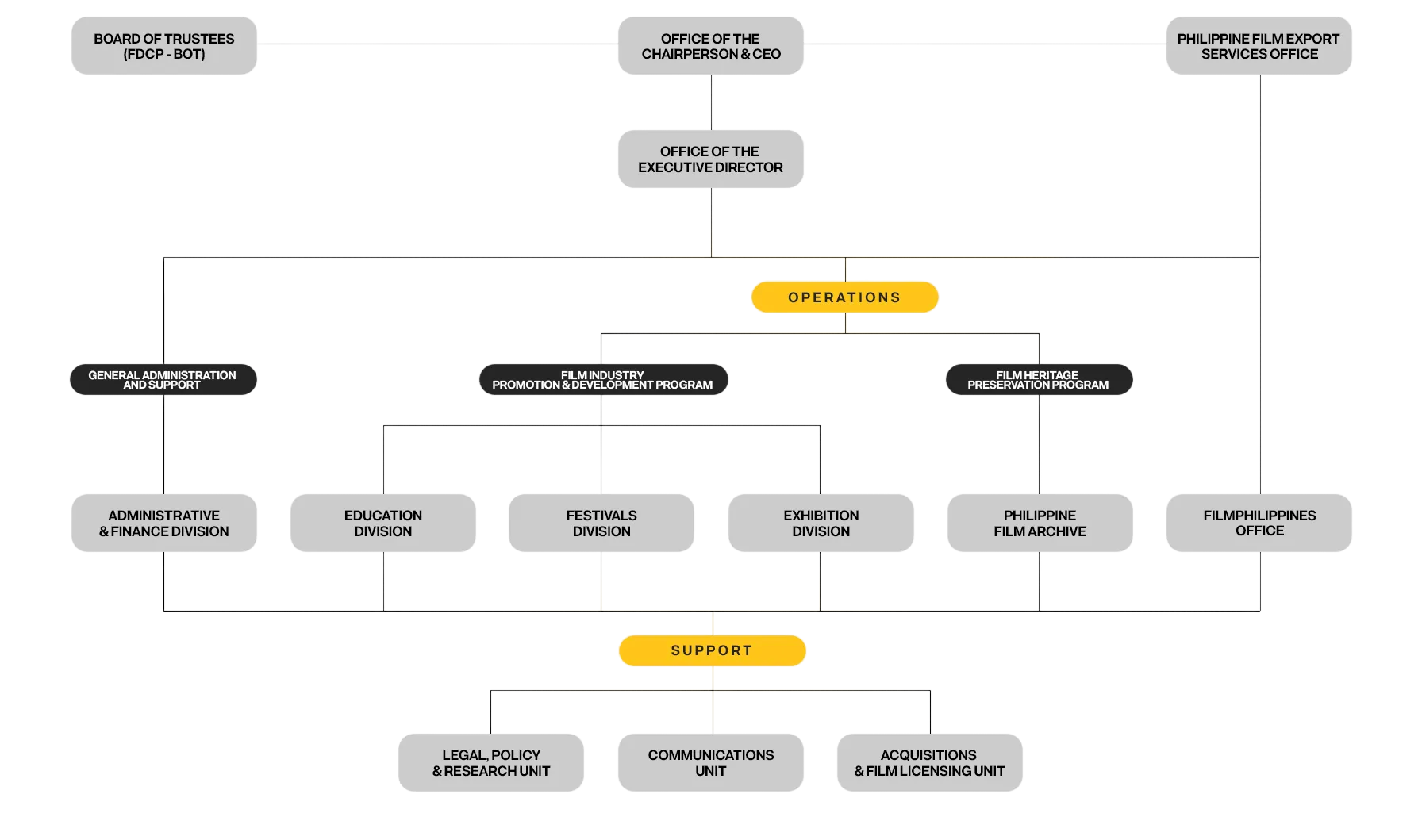
The Film Development Council of the Philippines (FDCP) under the Office of the President of the Philippines was created by virtue of Republic Act No. 9167, replacing the Film Development Foundation of the Philippines, Inc., (FDFPI). The Film Rating Board (FRB) was also replaced by the establishment of the Cinema Evaluation Board, which evaluates and grades films submitted to the FDCP based on the Cinema Evaluation System. [5]

June 7, 2002
March 10, 2006

The power of the President under Section 17, Article VII of the Constitution to exercise oversight function over the Film Academy of the Philippines and the Film Development Council of the Philippines is delegated to the Secretary of Education through Executive Order No. 513. [6]

The Philippine Film Export Services Office (PFESO), under the administrative and technical supervision of the FDCP, was established through Executive Order No. 674. The PFESO is mandated to maximize the country’s comparative advantage as a location site for international movie and television program productions to generate income, promote tourism, and enhance the country's image abroad. [7]

October 30, 2007
June 15, 2009

Executive Order No. 674, which established the PFESO, was amended to include the Department of Foreign Affairs as one of the members of the Philippine Film Export Services Office via Executive Order No. 674-A. The DFA and the PFESO endeavor to present the best image of the Philippines to the world. [8]

The Film Development Council of the Philippines is placed under the oversight of the Department of Education via Executive Order No. 837, pursuant to the President’s continuing authority to reorganize the administrative structure of the Office of the President as stated in paragraph 2, Section 31, Chapter 10, Title III, Book III of the Administrative Code of 1987. [9]

October 20, 2009
January 2011

The Philippine Film Archive (PFA), formerly known as the National Film Archive of the Philippines (NFAP), was established by the FDCP, pursuant to the mandate to establish a film archive as stated in Section 3 (10) of the Republic Act No. 9167, and launched on October 27, 2011, as nations celebrated the World Day for Audiovisual Heritage. PFA is tasked to take charge of the preservation, restoration, maintenance, and safekeeping of all Filipino films and other audio-visuals produced in the Philippines or abroad. [10]

Administrative Order No. 26 was released by the Office of the President to prescribe rules on the deposit of copies of films and other audio-visuals to the National Film Archive of the Philippines. The AO is to direct all departments, agencies, and offices of the Executive Branch of the government, including government-owned or government–controlled corporations, to turn over to the NFAP their existing original or copies of films and other audio-visual negatives, prints, or digital files, including, but not limited to, moving films, documentaries, and animation, for the NFAP’s care, preservation or reconstruction. [11]

April 17, 2012
November 8, 2018

Declared 12 September 2019 to 11 September 2020 as the official celebration of the “Centennial Year of Philippine Cinema” through Proclamation No. 622. The Film Development Council of the Philippines was designated as the lead agency that will execute programs, projects, and activities for the celebration. September 12 also marks the birth of Philippine Cinema, as the first Filipino-directed and produced feature film Dalagang Bukid by Jose Nepomuceno premiered in 1919.  [12] 

Declared the month of September as the “Philippine Film Industry Month” (PFIM) under Presidential Proclamation No. 1085. The Film Development Council of the Philippines, as the lead agency in observing the PFIM, has organized programs and activities to recognize and celebrate the invaluable achievements of all the stakeholders and sectors of the film industry. [13]

February 3, 2021
January 7, 2022

The Film Development Council of the Philippines has transferred the oversight from the Department of Education to the Department of Trade and Industry via Executive Order No. 161, pursuant to the President’s continuing authority to reorganize the administrative structure of the Office of the President as stated in paragraph 2, Section 31, Chapter 10, Title III, Book III of the Administrative Code of 1987. [14]

BOARD OF TRUSTEES

ORGANIZATIONAL CHARTS

WHAT WE DO?

Learn More
Logo

MEET THE MANAGEMENT